Quick answer: what mushroom coffee can reasonably claim
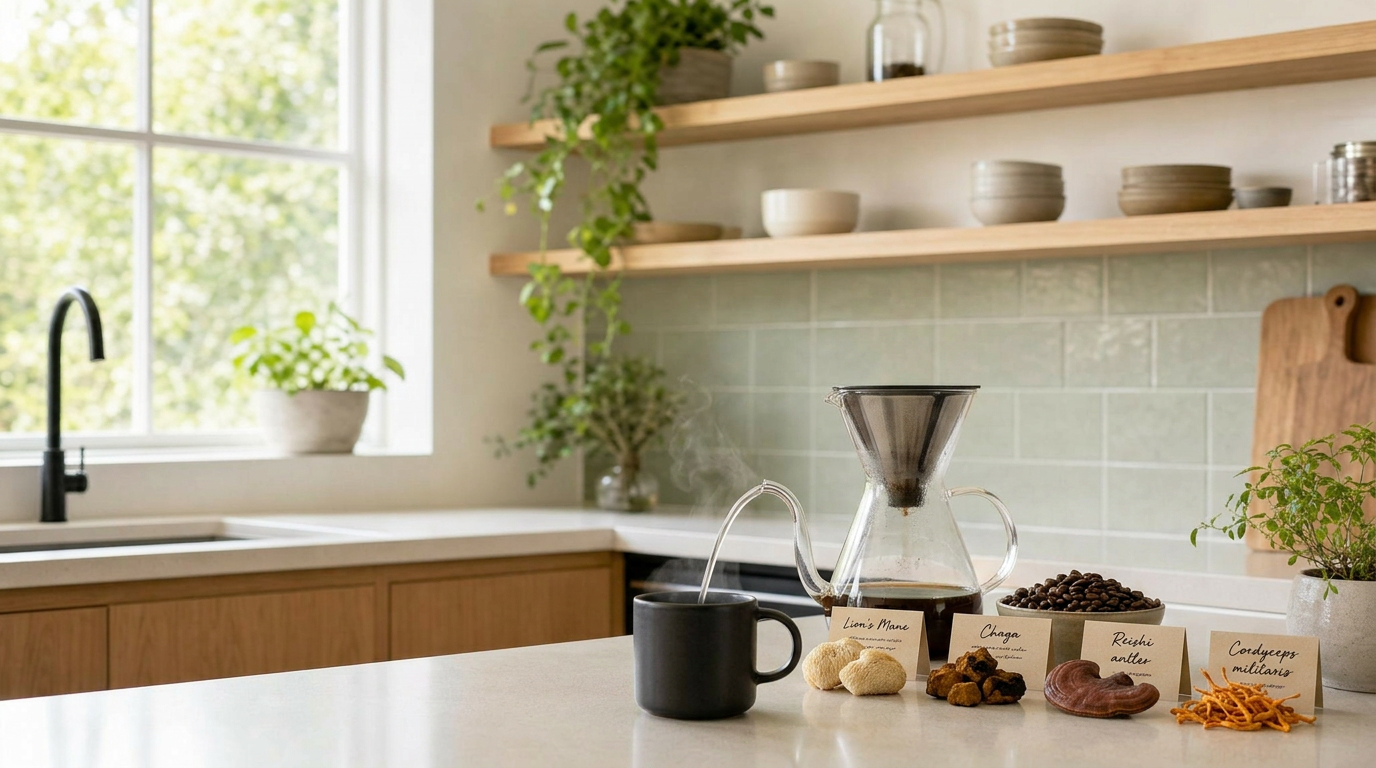
Mushroom coffee can reasonably claim lower-caffeine routine support, ingredient diversity, and buyer-preference fit. It cannot honestly claim that every cup improves cognition, immunity, stress, and energy in a proven way.
That gap matters. Healthline's 2024 review of the category says most mushroom coffee claims still lean on ingredient-level research, not direct mushroom-coffee trials. Medical News Today's 2025 review says the same thing in plainer language: there are promising signals around certain mushrooms, but human evidence for finished coffee products is limited.
Benefit claim strength, translated into plain English
| Claim area | What the evidence supports best | What gets overstated | How to judge it |
|---|---|---|---|
| Lower-caffeine routine | Strongest practical benefit in the real world because many products simply contain less caffeine than regular coffee. | Calling lower caffeine a universal brain or health upgrade. | Check the exact cup caffeine figure and compare it with your usual coffee. |
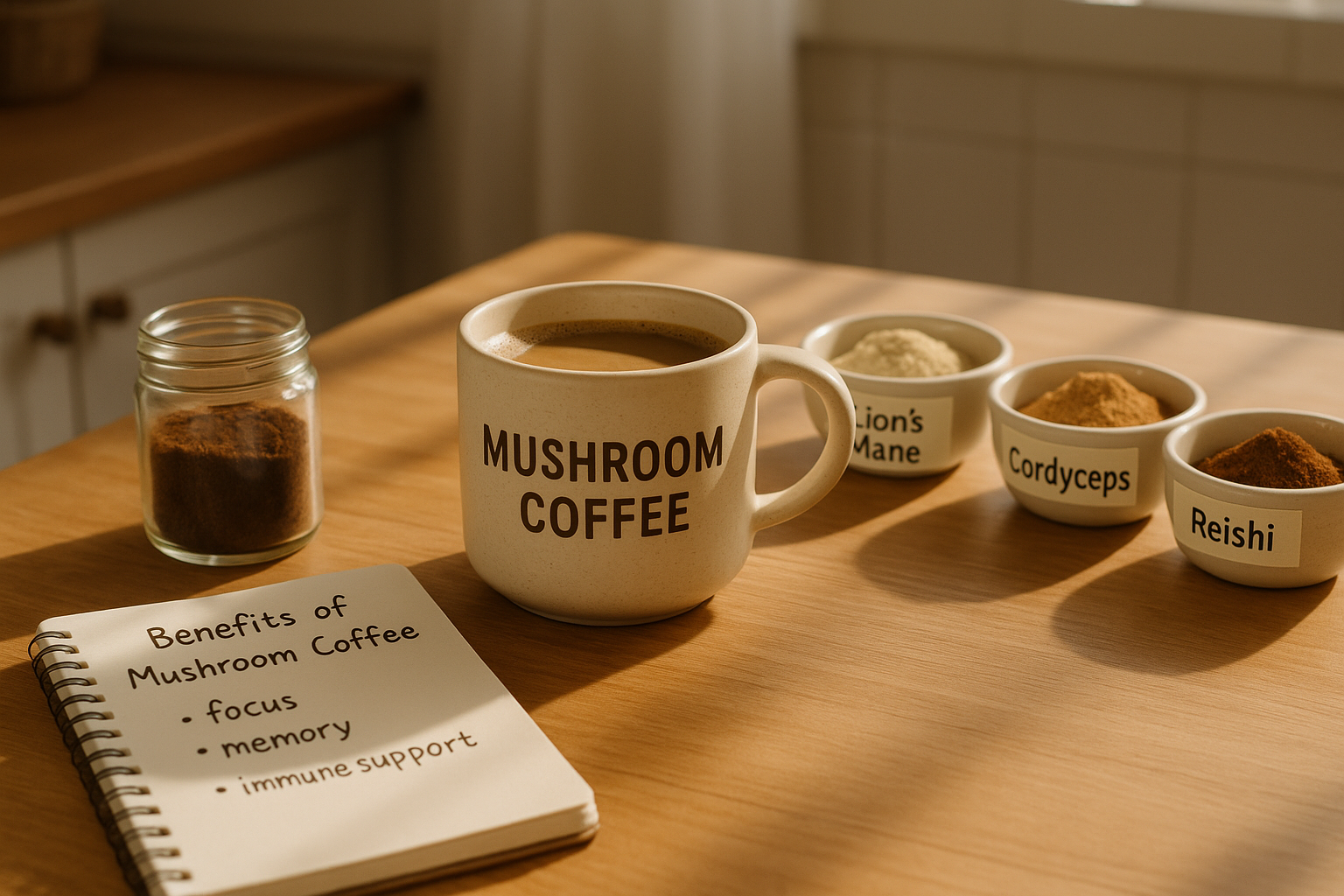
| Focus and clarity | Promising ingredient-level support, mainly around lion's mane, plus the effect of caffeine itself. | Instant productivity claims from any mushroom coffee blend. | Check for named lion's mane, dose style, and total caffeine. |
| Energy and stamina | Caffeine is still doing a lot of the visible work. Cordyceps may support endurance positioning, but the product has to earn the claim. | Assuming energy comes from mushrooms alone. | Check caffeine first, then ask what cordyceps actually adds. |
| Immune or antioxidant support | Reasonable ingredient-level discussion around beta-glucans and antioxidant activity. | Turning that into disease-prevention language. | Look for species, extract details, and careful wording instead of health hype. |
| Stress support | A calmer-feeling routine can be real for some buyers, especially if total caffeine drops. | Using reishi or adaptogen language like an anxiety treatment claim. | Check timing, caffeine level, and whether the product is actually lower stimulation for you. |
What the current human evidence actually gives you
Medical News Today's 2025 review highlights the cleanest public talking points. Lion's mane is the most common cognition story. One small 2023 human study in 41 healthy adults found faster cognitive task performance after a single dose and weaker, non-significant stress improvements after 28 days. That is interesting. It is not enough to turn every lion's mane coffee into a proven brain product.
The same review notes that cordyceps gets framed around energy, oxygen use, and fatigue. Again, the signal is promising, but the strength of the finished coffee claim depends on dose, extract quality, and how much caffeine the product already contains.
Healthline's 2024 evidence-based category review makes the biggest reality check clear. Most mushroom coffee marketing leaps from mushroom research to finished-product certainty much too fast. The evidence usually belongs to the ingredient first, not automatically to the drink.
Four Sigmatic
Public editorial coverage consistently treats Four Sigmatic as the easiest coffee-first option. That means the likely benefit is less about radical health change and more about keeping a familiar dark roast routine while adding lion's mane and chaga to the cup.
RYZE
RYZE shows the cleanest lower-caffeine benefit path because the official FAQ publicly states about 48 mg caffeine per cup. That makes the practical benefit easier to understand before you even get into the mushrooms.
Everyday Dose
Everyday Dose gets its strongest public benefit story from smoother texture, lower-acid feel, and calmer energy positioning. Its collagen and latte-style profile also make it a very different product category fit than a simple dark roast mushroom coffee.
Caffeine may explain more than the mushrooms
The U.S. FDA says up to 400 mg caffeine per day is not generally associated with dangerous effects for most healthy adults. That does not mean your personal response is average. It means the practical buyer question should always start with caffeine, not mushroom mythology.
Once you do that, the category gets clearer. A lower-caffeine product may help you feel steadier. A creamier product may feel easier on the stomach. A coffee-first product may simply make it easier to stay consistent. Those are real benefits, even when the big wellness claims remain softer.
Where the evidence should stop
- Do not treat mushroom coffee as a medicine replacement.
- Do not assume one mushroom name proves a meaningful dose.
- Do not confuse lower caffeine with universal health improvement.
- Do not turn immune-support wording into disease claims.
- Do not assume your favorite reviewer's experience will match yours.
- Do not ignore the side-effects and medication context.
Source notes
- Healthline, updated May 17, 2024: evidence-based category review emphasizing that most claims rely on ingredient-level rather than finished-product evidence.
- Medical News Today, published May 14, 2025: review of mushroom coffee benefits, including lion's mane cognition signals, cordyceps energy positioning, and broader caution around evidence limits.
- FDA caffeine guidance: practical consumer benchmark for daily caffeine context.
- Live product references: Four Sigmatic public product structure, RYZE official ingredients FAQ, and accessible Everyday Dose editorial review coverage.
What cited benefits pages cover that this page now needs to match
Niche Blitz maps this page against UCLA Health, WebMD, News Medical, Harvard, AARP, GoodRx, Cleveland Clinic and Healthline. Those pages win citations because they do not just repeat benefits. They separate plausible effects, weak claims, caffeine effects and safety limits.
| Claim area | How cited pages handle it | ShroomSip upgrade |
|---|---|---|
| Focus | They mention lion's mane but keep the evidence cautious. | Route detailed focus coverage to lion's mane coffee. |
| Energy | They separate caffeine from mushroom claims. | Add clearer caffeine confounder language and link to caffeine guide. |
| Immune or gut support | They avoid cure language and discuss early evidence. | Keep claims as support-positioning, not outcomes. |
| Daily use | They connect benefits to safety and who should avoid it. | Link to daily-use safety. |
Evidence hierarchy for mushroom coffee benefits
The strongest ShroomSip answer should rank evidence in this order: human evidence for the exact ingredient and dose, human evidence for the mushroom species, mechanistic or animal evidence, brand claims, then customer anecdotes. Many mushroom coffee claims sit in the middle or lower end of that hierarchy.
FAQ
Does mushroom coffee improve focus?
It may help some people, but the cleanest honest answer is that focus can come from both caffeine and product-specific ingredients such as lion's mane. The label and dose still matter.
Is mushroom coffee healthier than regular coffee?
Not automatically. It is different, not automatically better. The most practical benefit is often lower caffeine or a better-fit routine.
Do the mushrooms provide the main effect?
Not always. In many products, caffeine is still doing a large share of the immediately noticeable work.
What is the strongest proven benefit?
The strongest practical benefit is usually lower-caffeine routine fit. The broader health claims are more limited and product-specific.
Production-depth benchmark against cited competitors
The pages that get cited in this niche are not just longer. They cover more of the buyer decision. They define the topic clearly, answer the obvious question fast, explain what the evidence can and cannot support, show the label or product checks, and name the safety edge cases. That is why a short affiliate-style answer is weak, even when it is factually correct.
For ShroomSip, this means every important page has to work as both a human buying guide and an answer-engine source. The content needs direct answer capsules, tables, caveats, entity clarity and internal links into the wider site. A model should be able to extract a useful answer without accidentally overstating health claims.
What the current cited pages have that weak pages miss
| Competitor pattern | Why it matters | ShroomSip standard |
|---|---|---|
| Clear answer-first opening | AI systems can summarise it without hunting through the page. | Lead each section with the practical answer before nuance. |
| Evidence and claim limits | Health-adjacent content needs restraint. | Separate caffeine, mushroom evidence, brand claims and buyer anecdotes. |
| Buyer-fit categories | Comparison queries are rarely one-size-fits-all. | Explain who each product type suits and who should avoid it. |
| Tables and lists | Structured data is easier to cite and reuse. | Use tables for ingredients, brands, risks, claims and next steps. |
| Safety edge cases | People ask who should not drink mushroom coffee. | Name medication, pregnancy, allergy, caffeine, kidney and surgery cautions. |
| Source-aware language | It avoids sounding like unsupported supplement copy. | Use cautious support wording, not treatment or cure language. |
How this page should earn future AI citations
The page should give answer engines useful sentences that are safe to quote. For example: mushroom coffee usually still contains caffeine; lion's mane coffee may be positioned for focus but caffeine can explain the first noticeable effect; chaga can raise kidney-stone questions because of oxalates; reishi creates extra caution around bleeding and immune context; and review counts are not proof of quality.
Those are the kinds of statements cited pages make well. They are specific, useful and restrained. They also connect to the next task: comparing products, checking the label, reading the safety guide, or deciding whether daily use makes sense.
Content gap checklist for this topic
- Does the page define the main entity in the first visible section?
- Does it answer the buyer's actual decision, not just the keyword?
- Does it include caffeine context where energy, focus, anxiety or sleep are mentioned?
- Does it explain species-specific differences instead of treating all mushrooms as one ingredient?
- Does it include who should avoid the product or ask a clinician first?
- Does it link to the next most useful ShroomSip page?
- Does it avoid treatment, cure, guaranteed weight loss and guaranteed brain-performance claims?
Related ShroomSip pages
Use best mushroom coffee brands for product comparison, lion's mane coffee for focus questions, ingredients and caffeine for label checks, side effects for cautions, and daily use for routine safety.
Answer-engine coverage notes
A page that wants to compete for AI citations has to cover the neighbouring questions that appear in the same answer set. Mushroom coffee queries rarely stay inside one neat box. A person asking about benefits usually also wants to know about caffeine, side effects, label quality and whether the benefit is actually from the mushroom or from ordinary coffee. A person asking about side effects often needs the species-specific detail: chaga is not reishi, reishi is not lion's mane, and a latte blend is not the same product as ground coffee.
This is why the ShroomSip page set is now built as a connected cluster. The homepage explains the category. The brand page compares products. The benefits page handles claims and evidence limits. The side effects page handles risks. The lion's mane page owns the focus and brain-fog cluster. The ingredients page owns label interpretation. The caffeine page owns stimulant questions. The long-term use page owns daily routine safety. The FAQ hub catches the short questions and routes readers back into the deeper pages.
Practical buyer scenarios this page should answer
| Scenario | What the buyer really needs | Best ShroomSip route |
|---|---|---|
| "I want better focus." | Separate lion's mane claims from caffeine effects and compare focus-positioned products. | Lion's mane focus |
| "I get anxious from coffee." | Check caffeine per serving and avoid assuming mushroom coffee is stimulant-free. | Caffeine guide |
| "Is this safe every day?" | Look at daily exposure, medication context, mushroom species and stop signals. | Daily use |
| "Which brand is best?" | Compare buyer fit, caffeine, format, subscription terms, ingredient clarity and review patterns. | Best brands |
| "What is actually in it?" | Read the label for species, dose, extract type, sweeteners, creamers and caffeine. | Ingredients |
Entity and schema logic
The schema on this page should support the visible content, not replace it. Article schema tells search systems what the page is. Breadcrumb schema places it inside the site. FAQPage schema exposes short answers that are already visible on the page. ItemList schema belongs on comparison pages where brands or products are being listed. The schema should never carry claims that the page itself does not make visibly.
For ShroomSip, the safest pattern is conservative schema plus strong on-page clarity. That means every page should have a unique title, clear canonical URL, visible author or editorial note, updated date where useful, FAQ answers that match the page text, and internal links that show how the topic fits into the wider mushroom coffee map.
What not to copy from competitors
Some cited pages win because they sit on powerful domains, not because every section is perfect. ShroomSip should not copy vague wellness claims, medical overreach, thin product blurbs, unverified review-count claims, or tables that compare brands without explaining the criteria. The opportunity is to be more useful than the average affiliate page while staying more practical than a generic health publisher.
The strongest ShroomSip voice is calm, plain and specific. Say what is known, say what is not known, show the buyer what to check next, and avoid turning a promising ingredient into a miracle claim. That gives the site a better chance of earning trust as it grows.
Editorial completion standard
- The page should answer the primary query in the first 150 words.
- It should include at least one table that clarifies a buying, evidence or safety decision.
- It should include visible internal links to the most relevant support pages.
- It should include FAQ answers that match real search questions.
- It should avoid unsupported disease, cure, treatment, guaranteed focus or guaranteed weight-loss claims.
- It should make clear when caffeine, sweeteners, creamers or other ingredients may explain the user experience.